Friday, September 13, 2013
Super Model Rooms
Whenever I visit antiques shows, my attention is captured by all kinds of booths and displays. But the booths that remain most memorable to me, even years after attending a show, are those where some amazing, unbelievable, one-of-a-kind find was displayed or those that were decorated to resemble chic living spaces. I think that for those of us with a yen for decorating, we can't help but be drawn to exhibit spaces with strong decorative appeal, even if the wares being displayed aren't anything special. True connoisseurs might cringe, but I think it's the truth.
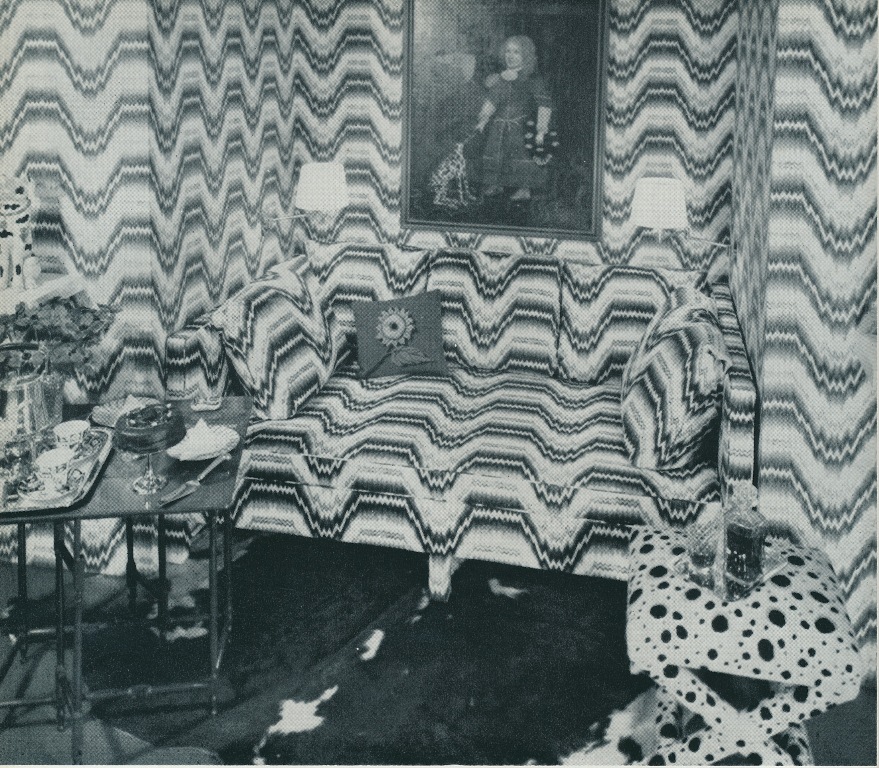
Had I attended the fifth Biennale des antiquaires in Paris back in 1970, the rooms seen here, which I believe were part of the show, would have been etched into my memory. If my English translation is correct, these model rooms were decorated by Jean Dive of Galerie Maison et Jardin. I'm not familiar with this show, so I don't know if model rooms were/are a regular feature. No matter, because there is much to look at, namely richly upholstered seating mixed with sleek, contemporary brushed steel and lots of Chinese pieces thrown in for good measure. It might be a bit much to absorb, but this cocktail of furnishings does require one to linger over these photos, just as the show's guests must have lingered in these super model spaces.
All photos from Decoration- Tradition et Renouveau
Wednesday, September 11, 2013
Babe Paley's Secret Garden
I know little- very little- about gardens and gardening, and perhaps one of these days I'll remedy this situation. However, I suppose that I know enough to be familiar with Russell Page, the esteemed British garden designer. And, of course, the whole world knows who Babe Paley was. So, whether you're a garden aficionado or a novice like me, you might be interested in these photos, which depict the Russell Page-designed garden of Babe and William S. Paley.
Located at their Long Island estate, Kiluna Farm, the garden was designed mostly by Page, with additional input provided by Paley's friends, Henry Francis du Pont and Thomas Church. When the Paleys purchased this property, the garden lacked "mystery", according to Babe, and felt "too constricted and enclosed," especially considering that dense woods hovered beyond its rose beds. Paley decided that a new garden was in order, one which would cut into the untamed woods and have a proper focal point. Mrs. Paley also wanted a "secret garden" feel to the space.
Page and Paley first cleared out a dell that would serve as the garden's focal point, and then planted it with a so-called "punch bowl", which was essentially an oval pond that was surrounded by grass. The "outer frame" of the punch bowl was planted with various groundcovers and flowering trees and shrubs. (You can see what all of this means in the photo at top.) Japanese azaleas were preserved from the old garden and replanted along the sides. In addition to the azaleas, you'll also see rhododendrons, dogwoods, oak trees, and tulip poplars.
If any of you garden-savvy readers wish to add any pertinent information or comments to this post, please do so. Even after reading the Architectural Digest article from which these photos came, I'm still a little muddled as to the intricacies of the garden's design. (And I'm still a little confused about the secret garden aspect. Is it that the garden doesn't fully reveal itself upon first glance???) I'm just hoping that the photos can and will do the talking!
All photos from Architectural Digest, November/December 1975, Richard Champion photographer.
Monday, September 09, 2013
A Blaze of Glory?
Flame stitch fabric. Do you love it? Hate it? Fall somewhere in between? Quite frankly, it has never been one of my favorites. I think that the problem is that there are flame stitch fabrics that look too old-fashioned or their colors are all wrong, and then there are those that look like they came out of a seedy 1970s interior.
I'm starting to change my tune, though. Recently, my cousin Karlyle mentioned to me that she still loves flame stitch. That comment made me start to reconsider this oldie. And then, I opened the August issue of British House & Garden, and there was Helen Cormack of Tissus d'Hélène, who had put together a fabric scheme for a fantasy drawing room that included the most beautiful flame stitch by Edmond Petit, "Point d'Hongrie". Cormack suggested using the fabric on the inside of a wing chair, with a dark green plain linen used for the outside. How clever!
Now, I know that we are supposed to make decisions for ourselves, but I admit that Cormack's endorsement of this fabric gave it added appeal. By all accounts, Cormack is the London doyenne of textiles, and her showroom is on my list of places to visit on my next (and hopefully soon) trip to London. So yes, maybe I was swayed. But still, I really think that I may further investigate "Point d'Hongrie". I'm thinking that it might be just the right fabric for my sofa's throw pillows. The fabric strikes just the right note for my apartment. It's proper and well-mannered looking, not to mention that it has depth and maturity. And yet, it isn't dull or, worse, seedy-looking. This might just be the perfect flame stitch fabric. Well, to me anyway.
"Point d'Hongrie" from Edmond Petit.
Other examples of flame stitch from the past (of which some are better than others):
A flame stitch vignette at Tiffany & Co., decorated by Inman Cook. c. 1960s.
A Bloomingdale's model room by Barbara d'Arcy.
Flame stitch wallhanging and upholstery in a 17th-century English room.
Flame stitch rugs in the bedroom of Michel Pignère, France, c. 1960s.
Image at top: House & Garden, August 2013; #2 House & Garden Guide to Interior Decoration; #3 House & Garden's Complete Guide to Interior Decoration; #4 Traditional Decorating by John Sutcliffe; #5 Nouvelles reussites de la decoration francaise, 1960-1966.
Friday, September 06, 2013
Executive Dining
Have you noticed that many vintage entertaining and tablesetting books devote at least a few pages to executive dining? It's quaint, really, because I believe that few of us devote much effort to weekday lunches, especially those we consume while working at our offices. In fact, I am writing this very post while eating Orzo Salad at my desk. It may not be a civilized way of eating, but it certainly is efficient.
But, back in the days when life was just a little bit less frenetic and when emails and social media were a burden yet to be discovered (and, by the way, when men wore suits and women wore dresses and skirts to work,) many people did take the time to enjoy a proper lunch. Sometimes they met friends at restaurants while at other times, they broke bread with their colleagues in the break room. A few brave souls ventured as far as three martini lunches (!) There was even a tradition in some offices, especially those of decorating establishments, of taking tea or coffee in the late afternoon, sometimes from a tea trolley that was pushed throughout the office.
Of course, not everyone had access to executive dining rooms, tea trolleys, and power lunches at the Four Seasons. But looking at these old books with their attractive workday tablesettings does make me realize that sometimes I really should slow down and enjoy life's little pleasures...even if that means eating Orzo Salad on proper china and at a proper table!
Image at top: In the 1930s-style Maple dining room of Cartier, a panther motif table was set for executives to discuss business. Note the wine and cigarettes.
"A Client Lunch at Wells, Rich, Greene, Inc." as conceived by Mary Wells Lawrence. Tiffany & Co.'s "Bamboo" flatware and "Jardin de Jade" china adorns the table, which is surrounded by Bielecky Brothers rattan chairs.
"A Small In-Office Lunch" at the Manhattan office of John T. Sargent, former Chairman of the Board of Doubleday. The table is set with "Si Kiang" china, "King William" flatware, "St. Remy" glasses, and a silver Monteith bowl filled with pears, all from Tiffany & Co.
"Luncheon at Chanel Inc.", where this fantasy lunch included Caprese Salad, grilled sole, and cantaloupe sherbet and gaufrettes for dessert.
"Lunch in the Corporate Boardroom" at the New York Bank for Savings. Letitia Baldrige, who was a trustee of the bank, set this table with Tiffany & Co.'s "King William" flatware.
Primrose Bordier set her table for a "brainstorming session with her colleagues." Asian accents include Philippine trays used as chargers, small Japanese hot towel baskets that served as bread plates, and Japanese porcelain bowls.
"Luncheon at an Executive's Desk" at the Time & Life Building, c. 1960. The table was set with tableware from Tiffany & Co., including what appears to be their "Hampton" flatware. I myself have "Hampton" flatware, but I have never once used it for lunch on a workday!
"Luncheon in a Board Room" at the Time & Life Building, c. 1960. Again, the tableware is from Tiffany.
Not a working lunch, but rather a working dinner in the Sutton Place apartment of the late designer, Valerian Rybar. The menu included cold lobster, brochettes of baby lamp chops grilled aux herbes de Provence, and eggplant caviar. A ginger-scented Crème Bavaroise would have been served for dessert. The table was set with vermeil pieces from Tiffany.
Photos from: "Tiffany Tablesettings", "New Tiffany Tablesettings", "Tiffany Taste", and "The Elegant Table" by Barbara Wirth.
Don't Forget!
If you are in Atlanta this weekend, be sure to stop by the estate sale at the Pink Palace/the Pink Castle. (The debate rages on as to its correct moniker.) The sale is being conducted by Parc Monceau Antiques. This is a rare opportunity to purchase effects from this old estate and to get a glimpse inside this landmark Atlanta home.
For more information, click here.
Wednesday, September 04, 2013
Valentino a Roma
A few weekends ago, two friends and I attended an estate sale at the now former home of design legend Dan Carithers. It was the second day of the sale, and, as would be expected, much of the sale's contents had been picked over. Fortunately, though, there were many books still for sale, and I ended up spending most of my time peering at and poring over the various titles. Lo and behold, a spine with "Decoration" printed on it in big, bold letters called my name. Turns out, the tome was the early 1970s Connaissance des Arts book, Decoration, Tradition et Renouveau, which I have only wanted forever. The only thing that had stopped me from buying it in the past was its hefty price tag. Lucky me, because this copy cost a mere $10. Score.
Later that day, I sat down to read through my new book and soon found these photos of Valentino's Rome apartment. Double score. I love everything about this apartment, including the brass fillet that outlined the walls, the rich colors, the antique Chinese porcelain mixed with shiny chrome and brass furnishings, and the fabulous tortoiseshell bathroom. In fact, if you look at the blue room below (perhaps a study of some sort?), you will see a pair of Qing-dynasty ancestral portraits. These portraits later appeared in Valentino's 1980s-era Rome apartment, which was decorated by Renzo Mongiardino in a grand, traditional style, and are now ensconced in his Chinoiserie winter garden at Chateau de Wideville. It seems that while Valentino decorated his homes to reflect the mood of a particular decade- like high-gloss swagger for the 1970s and romance and grandeur for the 1980s- one thing has remained constant: his love of all things Chinese.
Have to Have It!
I didn't think it possible to get excited over a waste paper basket, but indeed it is. I am absolutely smitten with these charming bins that are decorated with dioramas, which appear to made of paper reproductions of famous paintings, engravings, and maps. Depictions include The Hermitage, Brighton Pavilion, and the Fountain of Latona. All are available through Hollyhock Inc.
Leave it to Suzanne Rheinstein to find waste bins that are objects of beauty!
Friday, August 30, 2013
Study Abroad
Many of the great decorators have partially credited their success to their Parsons education. And some have specifically referred to their time spent abroad in Europe, where they were enrolled in the Parsons study abroad program, as an education from which they continued to benefit throughout their careers. It seems that their intensive studies, which included touring and learning about the great European houses and palaces, provided inspiration for years to come.
Such was the case with the late designer, Joseph Braswell, who studied at Parsons as a young man. According to the Jan/Feb 1975 issue of Architectural Digest, Braswell was engaged by his long-time St. Louis clients, the Yalems, to create a space for their inveterate entertaining. Braswell, with the assistance of architect William Bernoudy, conceived of the idea to create a separate pavilion that adjoined the clients' house, one which would be in keeping in the main house's architectural style. But when the designer began to flesh out his vision for this party pavilion, he thought thought back to his Parsons-era visit to Sanssouci, the Potsdam, Germany summer palace of Frederick the Great. Said Braswell, "I had seen it on a tour of Europe when I was a student at the Parsons School of Design. I never forgot it or any of its details. Certainly this was my inspiration for the Yalem pavilion."
Other than a reference to the Yalem pavilion's carved and gilded palm trees, the article does not mention other interior references to Sanssouci. However, I wonder if the Chinese House, a garden pavilion located in Sanssouci Park, provided the most direct source of inspiration. You can see that both structures are more or less similar in shape, and the Chinese House is surrounded by those glorious gilded palm tree columns, which also make appearances in the Yalem pavilion.
I think that Braswell did a marvelous job updating the notion of a pleasure pavilion. The pavilion's interior is certainly elegant and a little grand, much in keeping with the spirit of Sanssouci, and yet, it's got spunk, too, thanks to those lacquered red walls and that vivid yellow upholstery. In fact, one could imagine a modern-day Frederick the Great, perhaps a bachelor host and bon vivant, holding court, so to speak, in such style and splendor.
You can see Braswell's work on the Yalem pavilion, above. I can only imagine the fabulous parties that were hosted in those rooms.
Two images of the Chinese House at Sanssouci.
Braswell photos from Architectural Digest, Jan/Feb 1975, Norman McGrath photographer. Chinese House photos from wikimedia.
Subscribe to:
Posts (Atom)