Showing posts with label Givenchy. Show all posts

Thursday, February 23, 2017

Spy Les Giacometti


Everyone has been buzzing about Christie's upcoming Diego Giacometti sale, which will take place in Paris on March 6. Titled Les Giacometti d'Hubert de Givenchy, the sale is particularly noteworthy because all of the sale's twenty-one lots are being offered by legendary French couturier Givenchy, a noted Giacometti collector and friend who, according to the book The Givenchy Style, owns sixty some pieces of the artist's work.

Known early in his career as the assistant to his older and more famous brother, artist and furniture-maker Alberto, Paris-based Diego Giacometti eventually established himself as an artist in his own right, producing metal animal-motif sculptures and furniture that became highly coveted by the likes of Bunny Mellon, Henri Samuel, and Givenchy.

Though admittedly sad to sell part of his collection, Givenchy initiated this Christie's sales as a tribute to his late friend, who died in 1986. The sale's lots, scant in number but significant in importance, consist of pieces made specifically for Givenchy, including three highly-recognizable octagonal tables, some (or possibly all of) which have been ensconced in the couturier's country estate, Le Jonchet. Additionally, it should be noted that one of the lots does feature a piece made by Diego's brother, Alberto.

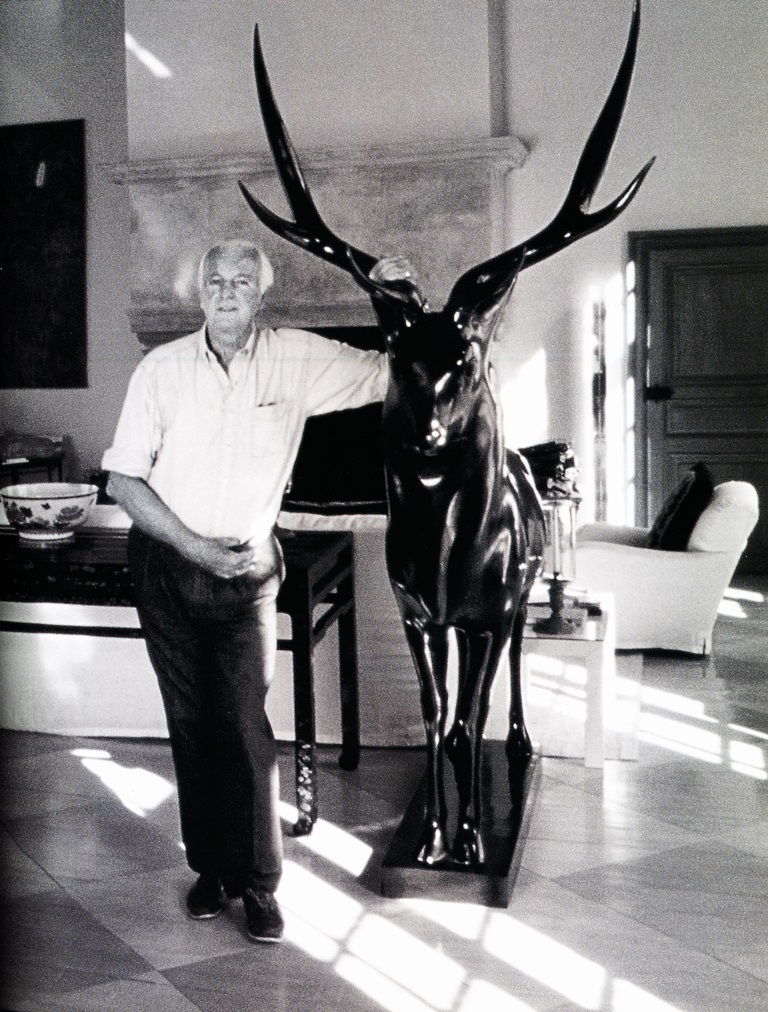
After learning of the sale, I revisited The Givenchy Style to see Giacometti's work in situ.  Below, you'll find photos of both Le Jonchet and Le Clos, the designer's retreat in the South of France.  Look closely at these photos, and you'll spy a number of the sale's lots.  And do be sure to visit the Christie's website, where you'll be treated to additional information on the sale plus a video tour of Le Jonchet's interiors.


Grande Table Octagonale aux Caryatides et Atlantes, c. 1983. Estimate EUR 800,000-EUR 1,200,000

Ensemble de Quatre Tabourets en X, c. 1983. Estimate EUR 300,000 to EUR 500,000


Tourterelle, c. 1975. Estimate EUR 20,000 to EUR 30,000


Grande Table Octagonale aux Caryatides et Atlantes, c. 1983. Estimate EUR 800,000 to EUR 1,200,000


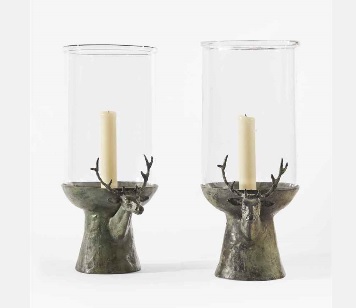
Paire de Photophores au Cerf, c. 1970. Estimate EUR 100,000 to EUR 150,000

Table, c. 1978. (Similar to the one featured in the Givenchy photo.) Estimate EUR 150,000 to EUR 200,000


Paire de Photophores aux Anneaux, c. 1970. (Similar to the one in the Givenchy photo.)  Estimate EUR 80,000 to EUR 120,000

Le Clos:


Deux Tables Basses à L'Oiseau et Coupelle, c. 1970. Estimate EUR 300,000 to EUR 500,000

Tuesday, October 18, 2016

Another Look at Le Jonchet


So frequently have the homes of M. de Givenchy appeared on my blog, I almost feel the need to apologize for once again showing you photos of one of the couturier's houses.  It's not that I'm obsessed with his aesthetic prowess, although I am quite enamored with it.  Rather, it seems like everywhere I look- in new books, old books, and decades-old magazines- one of Givenchy's homes almost always makes an appearance.

Such was the case when, over the weekend, I was browsing through a 1990 copy of House Beautiful Weekend Homes, which a friend recently gave to me.  There, among the chapters on houses decorated with quilts, baskets, and other hallmarks of Eighties Country Style, I espied photos of Le Jonchet, Givenchy's much-lauded country manor.  Compare these late-1980s House Beautiful photos to those in the book The Givenchy Style, presumably taken in the mid-to-late 1990s, and you'll see that while fundamentally the home's interiors remained the same between the two decades, Eighties effusiveness eventually gave way to some semblance of Nineties-era minimalism.

Take, for example, my favorite room in the house, the Braquenié "Le Grand Genois"-shrouded bedroom (fourth photo below).  Back in the 1980s, the bed was lavished with lace-edged bed linen, while tables held framed photos, vases, and other small objects.  But a decade or so later, the room seemed to have received a thoughtful edit.  Some of the room's more extraneous objects were cleared away, while that lacy bed linen was exchanged for bedding made from additional "Le Grand Genois" fabric.  While the transformation wasn't radical, it was enough to give the bedroom a slightly more modern appearance. 

Givenchy seems to have edited other rooms as well, resulting in a Nineties-era restraint that, at times, bordered on the monastic.  But even underneath the Eighties-era stuff, the rooms' good bones were evident.  Neutral-colored upholstery, both stylishly-plain and timelessly-patterned rugs, and a smattering of modern furniture and art ensured that these rooms would look chic always, no matter the decade.


Le Jonchet, as it appeared in House Beautiful in the late 1980s:


And as it appeared in The Givenchy Style, mid-to-late 1990s:


House Beautiful photos, Michael Dunne photographer.

Monday, February 01, 2016

A Potager Inspired by Mount Vernon


"I dress the garden with a new look each season- just like a collection." 

So said Hubert de Givenchy, whose gardens at Le Jonchet, his 16th-century chateau near Paris, appear to be a slice of verdant heaven.  Back in the mid-1990s, one of those new looks entailed the building of a new potager, or kitchen garden. Givenchy's first potager, seen below in image number two, had been inspired by Venice.  But for his subsequent potager, the designer sought inspiration in a classic American setting: George Washington's garden at Mount Vernon.

Whenever Givenchy visited his great friend, Bunny Mellon, the two made a habit of visiting Mount Vernon.  Those trips made a great impact on the designer, who later fashioned his potager's two pavilions and fencing after those at Mount Vernon.  As Givenchy explained, "I adore America and the idea of having a little bit of American perfection at Le Jonchet.".

It might be the pair of pavilions that I find most charming; in fact, I feature one of the pavilions in my "In with the Old" slide presentation.  While one pavilion was intended for use by the head gardener, the other was built for the designer's personal use.  That one is filled with elegant-yet-rustic furniture, gardening tools, and books.  "Each little thing in my pavilion comes from a trip and is something I love," said Givenchy.


The Venetian-inspired potager.


In his then-new potager, Givenchy chose board fences like those at Mount Vernon.


Above, the head gardener's pavilion.


Givenchy's pavilion.


The unique curved bench is a replica of one at Cawdor Castle, Scotland.

The view of the lake from the pool house.


All images from House Beautiful, Christopher Simon Sykes photographer.

Monday, August 10, 2015

The Classics: The Telescoping Table


Next month, I will celebrate nine years of blogging, and I can hardly believe it.  Back then, blogging was considered cutting-edge, but today, it's more like the éminence grise of the social media world.  So much has changed since 2006, and yet, in a way, much has stayed the same.  Nine years later and I'm still focusing my attention on those interiors and furnishings that have stood the test of time.

Some of you who have been with me for the long haul might remember "The Classics" series that I wrote a number of years ago.  Each of the series' blog posts featured furnishings that I considered to be classic.  Think Porthault linen, Brunschwig's "Les Touches" fabric, and Billy Baldwin's slipper chair.  (Little did I know back then that I would eventually develop this concept into a book, In with the Old.)  But it dawned on me last week that I had never written about a piece of furniture that is most definitely a classic: the telescoping table.

Look at the homes of Hubert de Givenchy, Howard Slatkin, and Alex Papachristidis, to name but a few, and you'll find at least one telescoping table, which is a small occasional table whose height can be adjusted thanks to a telescoping shaft.  You often see these tables constructed in brass, although they are made in others metals.  And although most owners seem drawn to round telescoping tables, you will find square versions in many a well-appointed home, too.  I have been told that those made by Maison Toulouse in the mid-twentieth-century are highly desirable, but also coveted is Matthews & Parker's nifty new version, which I recently saw in the Atlanta Brunschwig & Fils- Lee Jofa showroom.  Seriously, what's not to love about a table that is handy, adjustable, and, most important, classically chic?  And now, after having written this post, I covet a telescoping table even more than I did last week.  I'm moving this table to the top of my wish list.   

I always identify the brass telescoping table with Givenchy, who has quite a collection of them in his hôtel particulier in Paris.  The table in the top photo also belongs to Givenchy.


Howard Slatkin has a number of these tables in his home, including one that holds a candle and porcelain flowers and another that supports a stack of dinner plates.


Brian McCarthy must be a fan, as he used this round telescoping table in a client's home.


A square brass version in the former home of designer Alex Papachristidis.


And here, in Robert Couturier's living room, a telescoping table holds a cheery bouquet of pink flowers.


Photo #1: The Finest Houses Of Paris; #2: Private Houses of France: Living with History; #3 and #4: Fifth Avenue Style: A Designer's New York Apartment; #5: Luminous Interiors: The Houses of Brian McCarthy; #6: The Age of Elegance: Interiors by Alex Papachristidis; #7: Robert Couturier: Designing Paradises.

Wednesday, August 31, 2011

A Sterling Specimen


The two photos above have become etched in my memory. You might think that the 18th c. Chinese wallpaper has something to do with it, but that's only a minor part of this story. It's those silver-plated orange tree tubs that I'm gaga for. Are they not beautiful? The tubs and the dining room housing them are located at Givenchy's château at Le Jonchet. (The photos above as well as many other images of Le Jonchet can be found in Christiane de Nicolay-Mazery's terrific book French Interiors: The Art of Elegance. You can buy a new copy on Amazon for $62.50 or a used one for $99,999.99. Take your pick.)

According to de Nicolay-Mazery's book, Givenchy was inspired to commission the silver-plated tubs after similar ones owned by M. and Mme. Arturo Lopez-Willshaw. Unfortunately, I can find no photos of the Lopez-Willshaw tubs, although I wonder if photos of them ever appeared in any old auction catalogues. I even turned my library upside down trying to find images of other silver-plated tubs, but to no avail. I did, however, find a mention of Louis XIV's own silver orange tree tubs in Nancy Mitford's
The Sun King. (Mitford's book is really quite interesting, and the dust jacket is attractive too.) Of the Sun King's collection of orange trees, Mitford wrote, "The King was passionately fond of them and had them in all his rooms, in silver tubs."

Since I'm only showing a scant two photos of silver tree tubs, I'm including photos below of the Orangery at Versailles as blog post filler. If any of you know of other examples of these beautiful tubs, please let me know.


The Orangery at Chateau de Versailles


French Interiors: The Art of Elegance. Images of The Orangery at Versailles from Orangeries by Sylvia Saudan-Skira and Michel Saudan.