

I hope that my Atlanta readers will join me next Friday, February 3 for Drinks & Antiques- A Night for the Young and Savvy at The Cathedral of St. Philip. The party, part of the annual Cathedral Antiques Show, will be an opportunity for young designers and collectors to peruse the offerings of participating antiques dealers, all while socializing in a festive atmosphere. Of course, being able to purchase antiques and vintage pieces is enough of a draw for me, but in case you need a few more reasons to entice you, there will be music, libations, and both a slider station and a mac n cheese bar. But the most important reason to attend is that all proceeds benefit All About Developmental Disabilities (AADD). Tickets are just $40 in advance and $50 at the door.
To purchase, visit cathedralantiques.org/tickets
Hope to see you on the 3rd!
Tuesday, January 24, 2012
Drinks & Antiques- A Night for the Young and Savvy

Monday, January 23, 2012
Donghia and its Flagship Showroom

Last week's posts about fashion and interior illustrations seemed to resonate with many of you. A few (myself included) lamented the fact that illustrations seem to have gone by the wayside, while others were quick to inform me that there are still companies and designers who use, and in fact embrace, the artistry of illustrators.
Case in point- Donghia. Although I have not yet had the pleasure of visiting their new Manhattan flagship showroom, I hear it's really quite amazing. The 18,500 square foot showroom houses the lines of Donghia, Bergamo, Hinson, and Mrs. MacDougall. But while the showroom might be new, it is also respectful of the style of the company's late founder, legendary designer Angelo Donghia. Chuck Chewning, the Creative Director of Donghia, has added lacquered door casings, gold and silver leaf ceilings, and decadent finishes to the showroom, all of which were inspired by Angelo Donghia's interiors.
What is also quite clever, in my opinion, is that Chewning commissioned Masaru Suzuki, one of Donghia's acclaimed designers, to render illustrations of both the flagship showroom as well as those around the world. If you compare the illustrations to the actual photographs of the showrooms, you can see that Suzuki's renderings are indeed accurate representations. (Although that being said, Suzuki does note that art and accessories are items that are changed out seasonally, hence a few subtle differences between renderings and photographs.) The illustrations really seem to help flesh out the personality, style and energy of the showrooms, something that cannot always be captured by photographs. That's just my two cents.
And if you want to see the flagship showroom for yourself but have no plans to visit Manhattan anytime soon, you might want to watch a virtual tour via YouTube. Click here to see it.

Two images of the flagship Manhattan showroom, including a few framed photos of Angelo Donghia and his celebrity clients.
Suzuki's illustration of Donghia's Paris showroom.
Donghia's Moscow showroom, as represented by Suzuki.
And last but certainly not least, Suzuki's rendering of the Chicago showroom.
All photos and illustrations used with express permission of Donghia. All illustrations by Masaru Suzuki.
Friday, January 20, 2012
Billy Baldwin in Color

I wasn't planning to make this week "illustration week" on my blog, but I guess it's turned out that way. Illustration is still, I believe, an important means of rendering a room, although it's a trickier endeavor than perfume ads. Oftentimes, I find myself wishing that I could see an actual photograph of a room in order to really absorb the details.
The drawings shown here, executed by artist Sheridan Kettering, appeared in the September 1948 issue of House & Garden. According to the accompanying article, all of these drawings represent interiors done by Billy Baldwin while he was still with Ruby Ross Wood, Inc. Unfortunately, there is no other information about location, homeowner, etc. I tried to find actual photographs of these rooms, but came up with nothing. So, I've typed out the captions that appeared alongside each drawing in hopes that it might help a little.
I suppose we'll have to use our imaginations to flesh out these rooms. If any of you know any other details about these Baldwin designed rooms, do tell.
Bright walls are excellent as shock value in a transition room, here in Citron Yellow, tempered by a Copper-carpeted stair. Parchment-stone floor, iron rail, black-and-gold Queen Anne clock, green plants, set the foyer atmosphere, which should be formal and architectural, but alive.
Sprout Green velveteen curtains bound this dining room with positive color blocks. Black flock paper, black tile floor create an illusion of distant walls, draw the eye to Forest Green upholstered Biedermeier chairs and mahogany table, in which an Empire chandelier is reflected. Highlighting a room's center makes for good conversation on a black-tie evening.
Varied in a man's bedroom, cold and warm blues start at the French Blue floor, climb the scale through sturdy Bright Navy to the flash of Kingfisher Blue. See how, by keeping to one color, you gain two more which in a wider palette would be overlooked: the strong brown of French Provincial walnut, the dry-textured white of the cotton bedspread.
Against quite Stone Gray, spacious in a party room, Sweet Pink cotton voile curtains and Citron Yellow leather coffee tables look festive. The modern feeling of this room depends not on furniture (Empire and Chinese-inspired) but on monotone treatment with enough space around each color note to let it register.
Quartz Pink floor and walls make the shell of this lady's bedroom. Flame cotton taffeta bed cover is for drama, the glazed chintz butterfly print curtains are for prettiness. The Portuguese chair, painted gray and upholstered in horsehair, proves that antiques can sometimes be improved on.
White moldings, picked out as elegant tracery on Charcoal Purple walls, underscore paneling and support the theory that woodwork, as the "bones" of a house, should be uniform throughout. To keep the mood of the living room restful, armchairs echo the scheme, are covered in white and Purple Heather.
Wednesday, January 18, 2012
Illustrious Illustrations

I don't know about you, but I wish that fashion magazines and ad agencies would start using illustrations again. Am I the only one who is a little tired of seeing airbrushed photographs of the same models/celebrities/it girls wearing the latest fashions or hawking cosmetics and perfume? Take the 1955 Lancôme ad, above. Illustrated by artist E. M. Perot, the charming ad reminds me of Tony Duquette's whimsical drawings. As much as I like Kate Winslet as an actress, I would be much more inclined to buy Lancôme products if they used illustrations like those above rather than the current campaign featuring Winslet. Rather than being old-fashioned, illustrations might actually be a novel way to advertise in 2012. You know, in an "everything old is new again" kind of way.
I did a little sleuthing around the internet, and it seems that during the 1940s and 50s, Perot illustrated quite a few ads for Lancôme fragrance including Flèches, Marrakech, and Magie. I've included a few examples of his work below as well as two unusual ads that were not drawn by Perot. People collect these types of old ads and display them as art. I wonder if fifty years from now, people will be displaying Britney Spears perfume ads? I sure hope not.
Marrakech ad from 1947; Perot illustrator.
Another Perot ad for Flèches, Tropiques, Marrakech from 1949.
Tropiques, Flèches, and Marrakech fragrance ad c. 1949; Perot illustrator.
Magie ad from 1951. Perot, illustrator.
Magie and Trésor fragrances, hand in hand. Ad from 1946 and drawn by Perot.
Not by Perot, but this 1941 ad for Kypre is charming nonetheless.
And this appears to be a photograph rather than illustration. An armor hand holding a heart (its conquest) is a rather artistic way of selling perfume. Conquête fragrance, c. 1950.
Tuesday, January 17, 2012
Veuve Clicquot and Hotel du Marc

While we're on the subject of champagne, let's talk Veuve Clicquot. I'm partial to Veuve because it's what my family has always served during the holidays and on special occasions. While flipping through the Dec/Jan 2012 issue of French AD, I found these striking photos of Hotel du Marc, a private hotel owned by Veuve Clicquot. Located in Reims, France, the estate, once the residence of Madame Clicquot herself, was recently renovated and updated by noted architect Bruno Moinard.
Unfortunately, the hotel is not open to the public, serving instead as private guest quarters for those invited by the champagne house. The good news, though, is that we can get a taste of the interiors thanks to the AD article.


All photos from AD, Dec/Jan 2012, Mai-Linh photographer.
Monday, January 16, 2012
Breaking News: Albert Hadley's Homes For Sale

Many of you will be interested to know that both Albert Hadley's Manhattan apartment as well as his Connecticut home are for sale. If you're like me, you've probably spent hours studying published photos of his homes. In fact, I feel as though I've actually been inside both homes, although in reality, I haven't.
The Manhattan apartment, located on East 85th St., is priced at $1,350,000. Unfortunately, the Brown, Harris, Stevens listing for his Manhattan apartment does not yet have uploaded photos. For more information, click here.
The Connecticut listing can be viewed here. That home is listed at $575,000. I've included a few photos of that house here, but you'll definitely want to check out all of the listing's photos.
Stay tuned for more details...


Flown the Coupe

Over the weekend, I hosted a small birthday celebration for a good friend. Of course, no birthday party is complete without indulging in a few celebratory glasses of champagne. I have two sets of champagne glasses that I use for entertaining: plain flutes from Crate and Barrel and vintage coupes that once belonged to my grandmother. While I like my Crate and Barrel flutes because of their clean shape and their low price (something that alleviates any stress over breakage), I love my vintage coupes. They don't hold much champagne which means I'm constantly having to top off the glasses, but I don't mind because the coupes add to a party's festive atmosphere.
Coupes were once the glass in which to serve champagne. Oftentimes, they were spindly affairs with their shallow bowls perched precariously upon delicate stems. But then we were told that the only proper way in which to drink champagne was in a flute, its shape being better suited to keeping those bubbles from dissipating. (A coupe's shallow bowl allows champagne to go flat more quickly than in a flute. If you drink champagne like I do, though, it doesn't stay in the glass long enough to go flat.)
Looking through my old books and magazines, I very rarely see a flute. But starting in the 1970s or so, flutes seem to have supplanted the coupe in popularity. Fortunately, it seems that coupes are starting to make a come back, but I doubt they'll ever be as de rigueur as they once were. Somehow, coupes seem more fitting for evening wear and sparkling conversation than today's standard of jeans, flip-flops, and texting.
My vintage blue coupes, recently pressed into service to hold vodka and kosher salt for the tipsy tomatoes.
Something else that has gone the way of the coupe: fancy salads. This one is Lobster Salad Heligoland.
A "Special Occasion" lunch in which champagne was served... in coupes, of course.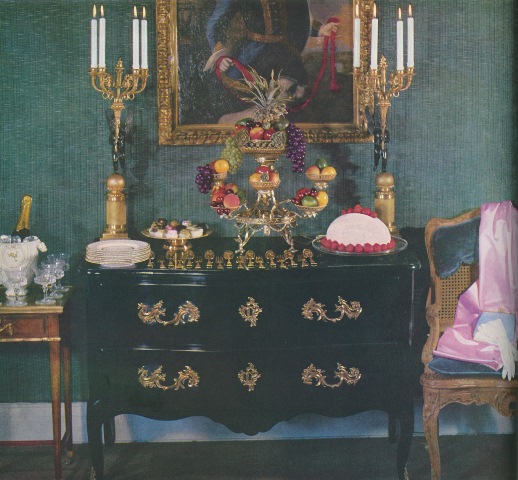
The glasses that Churchill Brazelton used to serve champagne look like a cross between a coupe and a heavy goblet.
For her 1980s Tiffany table setting, Nan Kempner chose trumpet flutes to go with her Piper-Heidsieck.
McMillen Inc. created a "Gypsy Tearoom á La Tiffany" table with Cristal champagne and hollow stemmed trumpet flutes.
Image at top: House & Garden, July 1948; images #4 and #5 from Tiffany Table Settings

Friday, January 13, 2012
A Little Dab'll Do Ya

While I was researching yesterday's post on The Divorcee, I found a terrific online resource for architectural artifacts: Urban Remains in Chicago. I ended up spending a lot of time going through their Art Deco period inventory which includes the 1930s startled cat door stop at top. I'm crazy for authentic Art Deco interiors, but I also know that there is a lot of Deco drivel out there. Deco flourishes can quickly careen into tacky territory. My advice would be that unless you live a Deco era home, go light on the Deco furniture and accessories. The pieces below are ones that I think would look great mixed in with other periods and styles.
A 1920s pendant light with baked black enameled accent.
These 1930s era metal stools are probably too short to be used at a kitchen island or a bar, but could be use for pull up seating around a table of some sort.
A novel pair of armillary table lamps, c. 1930s.
A pair of 1920s chrome plated, cast iron bookends.
I like the looks of this light, although you would really have to find the right space for it.
I like the shape of this mantel, although the varnished oak I'm not so crazy about.
If your first or last name begins with an "E", these door knobs might look nice in your dressing room, powder room, coat closet, etc.


