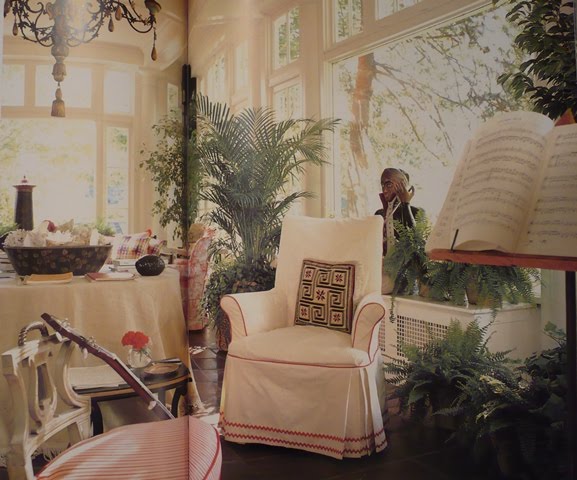
Showing posts with label Parish-Hadley. Show all posts

Tuesday, September 06, 2016

What Libraries Are For


"What's the room with all the books for?"  If you read Peter Haldeman's recent New York Times article on his experience with using a home stager ("The Twilight Zone of Home Staging"), then you were likely horrified by this quote, which was uttered by the stager upon seeing the author's home library for the first time.  Honestly, if someone came into my home and asked such a dumb question, I wouldn't know whether to laugh or cry.  I realize that people don't read like they once did, and I understand that, sadly, libraries are no longer symbols of aspiration like they were in the recent past.  But have our standards slipped so much that a home library is considered a detraction and not a luxury by many?

It seems to me that the Eighties was the last decade in which the library was lavished with attention, and two stellar examples from this decade are the libraries of Mrs. Charles W. Engelhard (today better remembered as the mother of Annette de la Renta)  and Carter Burden.  Both serious book collectors, Engelhard and Burden created not just some of the finest book collections in private hands, but two of the finest libraries to house them.

Converted from a former bedroom suite, Mrs. Engelhard's library was designed by architect Robert Raley and Parish-Hadley.  Perhaps reflecting the American focus of Mrs. Engelhard's collection of rare books and manuscripts, the library is efficiently designed and somewhat restrained in its furnishings.  The glass bookshelves were inspired by those at the Morgan Library, while the lighting was copied from that at Yale's Beinecke Library.  With its fireplace, round reading table, and leather-covered chairs, the library was, to quote Albert Hadley, "a little jewel of a room."

Burden's library, on the other hand, was more decoratively effusive, famously decorated by first Parish-Hadley and, later, the great Mark Hampton.  An obsessive collector of modern American literature, the late Burden said, "Books do not merely furnish my rooms, they engulf them."  (This was the man who also quipped, "You can never be too thin, too rich, or have too many books.")  But alongside those books were personal mementos, a flock of comfortable chairs, and layers of cosseting fabric, all of which must have encouraged hours upon hours of reading, reflecting, and relaxing, which is exactly what a room with all the books is for. 


The library of Mrs. Charles W. Engelhard, decorated by Parish-Hadley:


Carter Burden's library, decorated by Parish-Hadley and Mark Hampton:


All photos from House & Garden, March 1987, Oberto Gili, photographer

Wednesday, September 05, 2012

Brooke Astor and The Philosophers' Room


Funny enough, one of my favorite Parish-Hadley designed interiors is not Brooke Astor's library, although I do fancy it. Nor is it the yellow drawing room of the Paleys. Instead, it's the snappy-looking room seen above, one that was featured in Christopher Petkanas' Parish-Hadley: Sixty Years of American Design. What drew me to this Parish-Hadley room was not its leafy green vista, but rather the geometric-print fabric hanging on the walls combined with the blue lacquered bookshelves. To me, this room is so quintessentially American, comfortable in a crisp, chic, and casual way. Can't you just imagine what it must have been like to lollygag in this room on a Sunday afternoon?

The book only mentioned that the solarium was part of a 68-acre Westchester County estate, something which left me wondering for years who owned such a lovely garden room. But now I know where this room is located thanks to the Sotheby's catalogue for the Brooke Astor auction. It's at Holly Hill, Astor's estate along the Hudson River. Finally, the mystery is solved, although I'm sure that quite a few of you knew who the homeowner was long before the auction catalogue was published.

According to the catalogue, this is the Philosophers' Room, a fitting name for a room filled with such a collection of books. What struck me about the catalogue's photos, seen below, is how bright those blue bookshelves really are. I don't think they're being auctioned off, but the Roman marble head of a Satyr, perched on top of the bookshelf, is. (That too you can see below.) And wouldn't you love to see a close-up shot of the books? I can make out a few titles:
The Flowering of the Middle Ages; Pearls: A Natural History; American Rococo, 1750-1775: Elegance in Ornament. But the other titles in the library? I suppose that in a way, the mystery surrounding this room endures.


Image at top from Parish-Hadley: Sixty Years of American Design by Christopher Petkanas. The remaining photos courtesy of Sotheby's.

Monday, April 09, 2012

A Cavalier Attitude


Funny things happen when you become a dog owner. First, you find yourself taking lots of photos of your dog. See the photo above? It's just one of many photos that I've taken in the last month alone. Seriously.

The other alarming thing that I've noticed about myself is that I now take a keen interest in any and all tchotchkes that have a Blenheim Cavalier King Charles Spaniel emblazoned on them. I have bought magnetic note pads, stationery, and even socks (yes, socks) with Cavaliers on them. If I'm not careful, I'm going to become one of those squirrely dog owners who wears Cavalier sweatshirts and drives around with a Cavalier license plate on the front of the car. Well, I can't let that happen, so from here on out, I'm going to focus on collecting Cavaliers like these:


These two 19th c. English paintings of Cavaliers both have provenances listed as "Parish Hadley". Available through William Secord Gallery. I love that the two dogs have feathers and slippers just like Alfie. Alfie's tail, however, is much longer than those above.


Such a sophisticated Cavalier, one who is "Admiring Audubon"; Pamela Hall was the artist. Unfortunately, Alfie doesn't seem like much of a reader. (Painting available through William Secord Gallery.)


A c. 1860 micromosaic brooch by Castellani. Auctioned at Christie's London in 2006.


A c. 1890 Tea Caddy made of lacquer and papier mache. Available from Hamshere Gallery.


A c. 1780 Snuff Box depicting a King Charles Spaniel. From Taylor B. Williams Enamels.


A pastel drawing of "Roulette" by Marjorie Cox, 1963. Sold at Christie's in 1999.

Friday, March 30, 2012

My Tribute to Albert Hadley


It's with a very heavy heart that I'm publishing this post, one that I hope will be a fitting tribute to Albert Hadley. As I'm sure some of you are aware, Mr. Hadley died early this morning in his hometown of Nashville. It's strange how very sad I feel, especially considering the fact that Mr. Hadley and I were barely acquainted with one another. And yet, I feel as though I knew him quite well. His work resonated with me like that of no other designer. And truth be told, no other designer has taught me as much about design and living as Albert Hadley did.

There have been very few times in my life that I've been struck by the proverbial thunderbolt, but one indeed hit me while reading the Elle Decor cover story on Albert Hadley's Manhattan apartment (February/March 2000.) If there is such a thing as a perfect home, that was it. Yes, the rooms possessed more style and flair than most of us can ever hope to achieve in our own homes, but what mattered more to me was the apartment's complete lack of pretension. His home was just that: a home, one in which he surrounded himself with objects that had meaning for him or that simply struck his fancy. You could tell that nothing was chosen for show, but rather because it spoke to him. And in turn, his apartment spoke to me.

One of my dreams in life was to meet Mr. Hadley. I was fortunate enough to have spent time with him on three different occasions. But before meeting him, we had corresponded by mail. Shortly after starting my blog, I sent out holiday cards that I had designed using a photo of Sister Parish goofing off and holding an empty Jeroboam up to her mouth. A friend suggested that I mail a card to Mr. Hadley, and so I did. He responded with a very gracious letter in which he wrote, "Sister Parish would be thrilled to be the Christmas card for "The Peak of Chic"! I don't recognize the photograph, but she's certainly belting it out."

A few months later, I had a private meeting with him at his office. He was very generous with his time, answering all of the silly questions that I asked him. I was struck by his mild manner and his still-mellifluous Southern accent that seemed little affected after years of living away from the South. Seeing that I was a fellow Southerner, he was especially interested to show me framed drawings and sketches of the work that he did at Rosedown Plantation in Louisiana. I realized after that meeting that Mr. Hadley was not just a great designer, but a kind and courtly gentleman as well.

That was not to be my only meeting with Albert Hadley. Close to four years ago, the editors at House Beautiful assigned me an article to write about a wonderful Manhattan apartment designed by Mr. Hadley and his then associate Harry Heissmann. (House Beautiful, April 2009.) Once again, I made the journey up to the offices of Albert Hadley Inc., only this time I was armed with my tape recorder, pad, and pencil for an interview. I suppose that if there is to be one plum writing assignment in my life, that was it!

Mr. Hadley was the best kind of decorator. His primary concern was to create homes for his clients in which they could live comfortably and live well. He catered not to his whims but rather to the needs of his clients. And most impressive to me was that he encouraged young designers to get educated in the history of design and the decorative arts. He believed that without this foundation of knowledge, decorating with any kind of authority is difficult at best.

I realize that my tribute to Albert Hadley might border on hagiography, but death has not elevated Mr. Hadley to legend status nor design sainthood. He achieved that long ago during his exalted career. And it might seem hackneyed to say that his passing marks the end of an era, but in my mind, indeed it does. I feel fairly certain that the word "branding" never crossed Mr. Hadley's lips. And I do wonder if a humble, thoughtful person like Albert Hadley could succeed in today's world where never-ending self-promotion has become the norm.


There are other masters of design practicing today, and for that we should be thankful. But there will only be one Dean of American Decorators, and for me, Albert Hadley will bear that title forever.


Some of my favorite Albert Hadley and Parish-Hadley designed interiors:


The Manhattan apartment of Albert Hadley.


A mid-1970s era Manhattan living room in which Parish-Hadley used a mix of Alan Campbell fabrics.


A Palm Beach guest house bedroom. (Parish-Hadley)


A garden room at a Greenwich, CT show house. (Parish-Hadley)


Brooke Astor's Manhattan apartment. (Parish-Hadley)


The Manhattan apartment of the late Glenn Bernbaum of Mortimer's fame. (Parish Hadley)


Mr. Hadley's former country house in Tarrytown, New York.


A Manhattan bedroom designed for a bachelor. (Parish-Hadley)


Decorated by a young Albert Hadley, this room appeared in a 1959 Vogue article, "Summer on a Shoestring".


The guest sitting room of the Leonard Davis house, Palm Beach. (Parish-Hadley)


The "Dog Sitting Room" in the guest suite of the late Brooke Astor's apartment. (Parish-Hadley)


Mr. Hadley's Kips Bay show house room from 2001, "Homage to Van Day Truex". (Albert Hadley)


Mr. Hadley's Southport, Connecticut house.


All interiors photos with the exception of the first are from Albert Hadley: The Story of America's Preeminent Interior Designer by Adam Lewis and Parish-Hadley: Sixty Years of American Design by Christopher Petkanas, both terrific resources.

Monday, July 12, 2010

What's In a Name?


Well, if the name is Hager, then it means great style. I was slightly familiar with the work of the late designer Gary Hager, a former rising star in the interior design firmament and Parish-Hadley designer, but only slightly. A few weeks back, I picked up a copy of the 1989 book The Decorator and was obviously struck by his very handsome photo. But Hager was certainly not just a pretty face. His apartment, featured in this book, seemed so quintessentially American. In one of the images below, you see a bed covered in a wool plaid blanket with a Jean-Michel Frank mirror beyond in the entryway. Might this have been an Albert Hadley influence?

There was an elegance and tailored masculinity to Hager's work. I guess it's no surprise that in the book, he lists "fussy apartments, Art Nouveau, Tiffany lamps, and period rooms" as dislikes. But this post is not entirely about Hager's work. In fact, it's about serendipity. Within a few days of buying the book and admiring Hager's design skills, I was browsing through
Chris Spitzmiller's website and found my new favorite lamp- the Hager. And then it dawned on me. Might this be named for Gary Hager? Yes, it was. And Hager hailed from Spitzmiller's hometown of East Aurora, NY, yet another coincidence. So really, this post about Gary Hager-and his name- was really meant to be. Don't you think?


Hager's first New York apartment. Note the Jean-Michel Frank mirror in the hallway, a mirror favored by Albert Hadley. And, a similar mirror (though not a Frank piece) graces Chris Spitzmiller's entryway. The coincidences keep coming. That Directoire chair is quite fetching.


The living room of Hager's apartment. Those creamy walls are the perfect backdrop for the artwork and that beautiful Regency table.


Not Hager's apartment, but that of a client. Yes, the Impressionist painting and Miro sculpture are truly magnificent, but my money is on that bergere. Perfection.


The Hager lamp in a matte natural finish. I just love that hourglass shape.

(Hager images from The Decorator by Florence de Dampierre; Hager lamp photos courtesy of Christopher Spitzmiller website.